How to Wash Hair Gently and Limit Breakage
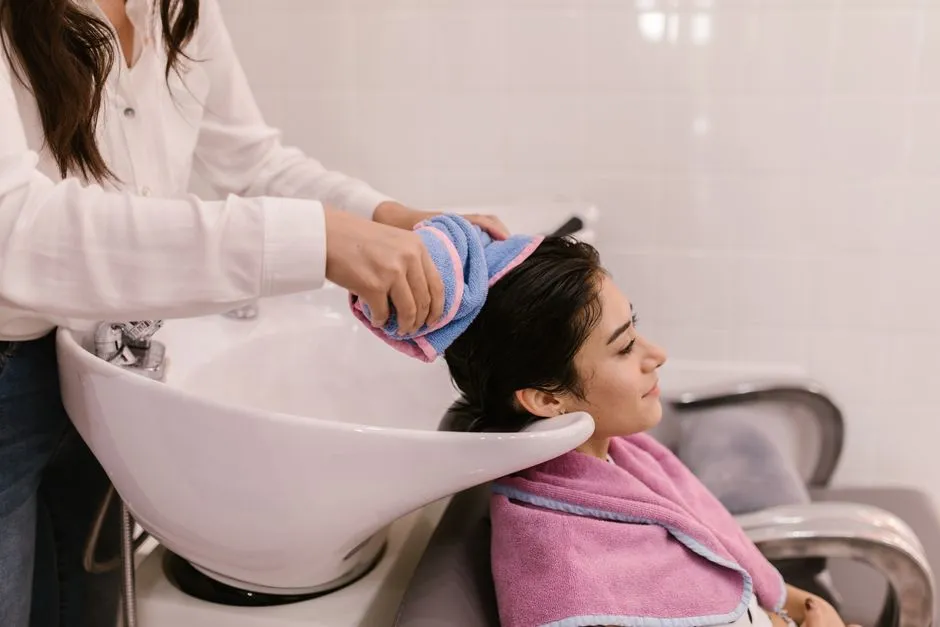
Gentle wash day is mostly friction management
To limit avoidable mechanical breakage, reduce tangling before shampoo, cleanse without piling hair on top of itself, use conditioner for slip, detangle in manageable sections, and blot rather than rub during drying. Adapt wet or dry handling to texture and current condition.
This is cosmetic care, not a hair-growth treatment. Sudden, patchy, painful, inflamed, scar-like, or otherwise concerning changes need appropriate professional evaluation.
Prepare before the water starts
Remove jewelry or clothing details that catch. Gather shampoo, conditioner, clips with smooth edges, a suitable comb or brush, and a soft towel or clean cotton shirt. Trying to find a clip while wet hair quietly becomes one large section is avoidable theater.
For straight or loosely wavy hair that tangles when saturated, gently separate major knots before washing. For tightly curled or textured hair commonly detangled wet, divide it loosely and wait for conditioner. No universal sequence fits every strand pattern.
Keep fingernails smooth. Use finger pads rather than nails on the scalp, and stop if handling causes pain.
Wet fully and shampoo where cleansing is needed
Use comfortably warm water and saturate the hair. Apply shampoo according to its label, concentrating where oil, sweat, and buildup collect—often the scalp and root area. Massage gently with fingertips.
Do not scrub lengths together or heap them onto the crown. As you rinse, let diluted lather pass through the rest of the hair unless the product instructions or heavy buildup call for targeted cleansing.
Repeat only when needed for the actual soil and product. More foam is not a certificate of better hygiene, and aggressive scrubbing is not exfoliation simply because it sounds industrious.
If a product burns, causes swelling, breathing trouble, or another reaction, stop using it, rinse as appropriate, and seek suitable medical help. Follow the label for warnings and any product-specific sensitivity test; do not invent a generic home patch test for a formula that gives different instructions.
Condition the lengths and create slip
Apply conditioner as directed, generally concentrating on the lengths that need it. Use enough to coat evenly without assuming more is always better. Let it remain for the labeled time.
Divide dense or long hair into sections. Work with fingers first, then use a smooth tool that suits the texture. Our detangling-tool guide compares wide-tooth combs, flexible brushes, paddle brushes, and fingers by use rather than miracle language.
Start at the ends. Hold the section above a tangle so force does not travel directly to the scalp. Make short, patient passes and move upward only after the lower section is clear. Add water or compatible conditioner if slip disappears.
If a knot will not release, isolate it and work individual strands from the outside. Do not keep pulling harder; the knot has already rejected that proposal.
Rinse without rebuilding the tangle
Rinse in the direction the hair naturally falls, supporting long sections. Follow the product's rinse instructions; some conditioners are meant to remain and others are not. Squeeze excess water gently rather than twisting the hair into a rope.
Apply a leave-in or detangler only according to its label and where needed. Check ingredients and avoid the scalp if the product says it is intended only for lengths.
Blot or wrap; do not scrub
Use a soft absorbent towel or clean cotton shirt to squeeze and blot. A loose wrap can absorb water, but it should not pull at the hairline or feel heavy. Avoid rough back-and-forth rubbing.
Let hair partially air-dry when that suits the texture, scalp, climate, and schedule. Air-drying is not automatically harmless in every circumstance, just as blow-drying is not automatically damaging at every setting.
For a dryer, use the lowest practical heat and airflow, keep it moving, and maintain the distance specified by the manufacturer. Use a labeled heat-protectant product as directed. Stop if hair or scalp feels uncomfortably hot.
Style without sustained pulling
Choose smooth accessories and avoid repeated tight tension, especially when a style hurts or tugs at edges. Pain is not a styling requirement. Rotate placement and give the hairline relief.
Keep heated tools within their manufacturer directions and use the lowest setting that achieves the intended cosmetic result. Exact safe temperature cannot be generalized across every hair condition and device. Never use a damaged cord or hot tool near water, and unplug and cool it safely after use.
The care routines collection favors observation over rigid calendars. Wash frequency depends on scalp oil, texture, activity, products, protective styles, and professional guidance.
Track whether the routine reduces tangling, snapping, roughness, and styling time. Those are cosmetic outcomes. If shedding or scalp symptoms change substantially, stop optimizing the routine like a spreadsheet and ask an appropriately qualified clinician to evaluate the person attached to the hair.